

Markup vs. Margin: Why a 40% Markup Isn't a 40% Margin
Quick answer
Margin is the share of the price you keep. Markup is how much you add on top of your cost. Adding 40% to your cost gives you only a 28.6% margin. To keep 40% of the price, divide your cost by 0.60 instead.
The full answer
It's the end of a busy month. Every change-out was quoted at "cost plus 40%," the crew stayed booked, and yet the profit came in short. Nothing went wrong on the jobs. The math went wrong on the quotes.
What's the difference between markup and margin?
Markup is what you add to your cost. Margin is the part of the final price you keep. They use the same starting number, cost, but they measure against different things: markup against cost, margin against the price. That's why the same percentage gives two different answers.
Why does a 40% markup only give a 28.6% margin?
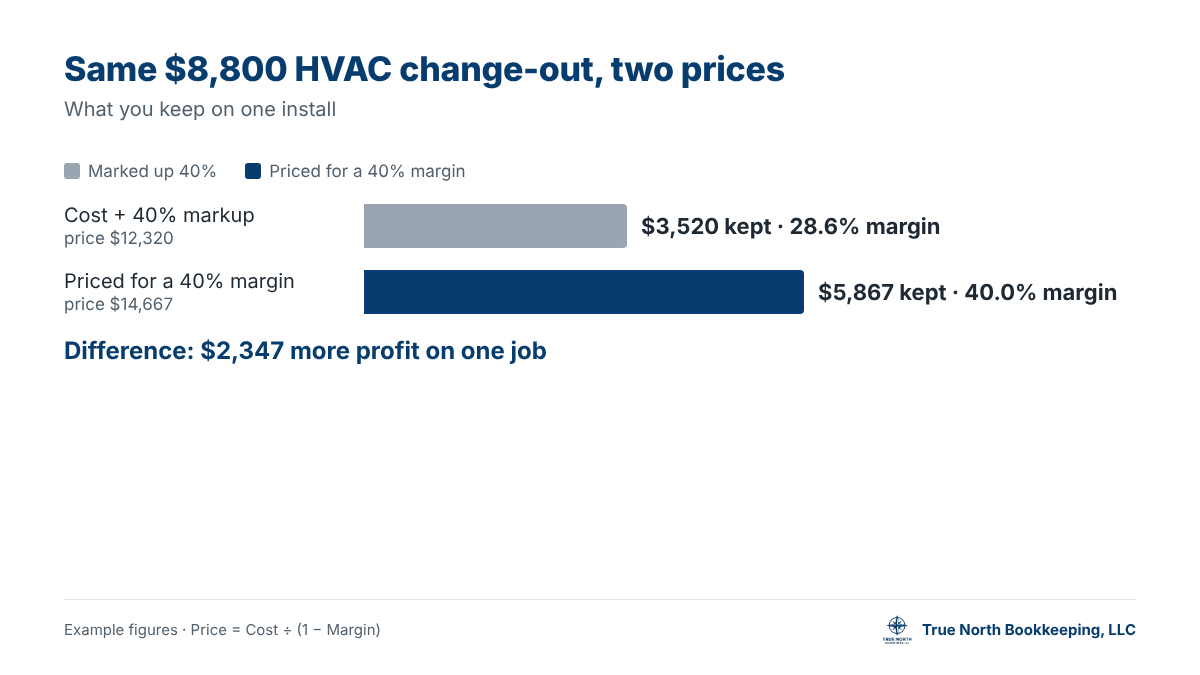
Take an HVAC change-out that costs $8,800 in equipment, materials and labor.
| Price | What you keep | Margin | |
|---|---|---|---|
| Cost plus 40% (markup) | $12,320 | $3,520 | 28.6% |
| Priced for a 40% margin | $14,667 | $5,867 | 40.0% |
The reason: the 40% was figured on the $8,800 cost, but margin is figured on the price. $3,520 is 40% of the cost, yet only 28.6% of the $12,320 price.
Marking up by 40% leaves $2,347 on the table on one install. Across a season of installs, that adds up to a truck payment, a hire, or your own paycheck.
How do I price a job for the margin I want?
Divide your cost by 1 minus your target margin.
- Price = Cost ÷ (1 − Margin)
- For a 40% margin: $8,800 ÷ 0.60 = $14,667
If you'd rather keep using markup, convert it first:
| Margin you want | Markup to use |
|---|---|
| 20% | 25.0% |
| 30% | 42.9% |
| 40% | 66.7% |
| 50% | 100.0% |
Keep one more thing in mind: this is gross margin, which only covers the job's own costs (labor, materials, subs). Your overhead and your profit still come out of it. If your overhead is high, your target margin needs to be higher too.
What to do this week
- Pull your last 5 quotes and work out the margin each one actually earned.
- Pick a target margin for each type of job (service, install, new construction).
- Put the conversion table where whoever writes your quotes can see it.
How True North helps
True North Bookkeeping keeps the books for electrical, plumbing, HVAC and painting companies and shows you, every month, the margin each kind of job actually earned. That way your pricing is based on your real numbers, not a rule of thumb.
Get the free Job Cost Worksheet: it includes a markup vs. margin calculator and a rate builder. Questions? Text Stephen at 623-738-5406.