

Had a good year and still no money in the bank? Five fixes to make before December 31.
A free, two-page checklist for electrical, plumbing, HVAC and painting companies, built on Stephen Lewis's year-end webinar with OCTA. Plain English, no accounting background needed.
The five fixes are free to read on this page, with no email needed. The printable checklist, with its fill-in worksheets, comes by email.
Profit and cash aren’t the same thing.
Your profit and loss statement says what you earned; your bank account says what you kept. Owner draws, loan principal, truck down payments, unpaid invoices and extra parts all take cash without lowering profit, and your taxes are figured on the profit. Here are the five fixes.
| Fix | What it means | Do this week |
|---|---|---|
| 1. Know your numbers every month, not every April | Books closed by the 15th of each month, and 30 minutes to read one page: revenue, gross profit, net profit, cash and what customers owe you | Ask whoever does your books: “Are we caught up through October?” |
| 2. Pay taxes a little at a time | A separate tax savings account. Move a set percentage of every deposit; your tax preparer helps you pick it. | Open the account. The Q4 estimated payment for 2026 is due January 15, 2027. |
| 3. Make year-end decisions on purpose | A write-off isn’t free money: a $70,000 truck that saves $15,000 in taxes still costs $55,000 in cash | Book a year-end meeting with your tax preparer before mid-December |
| 4. Build a cushion for your slow season | Monthly cost to run minus what a slow month brings in = your gap. Gap × slow months = your cushion. | Pull last January’s and February’s bank statements |
| 5. Know which work makes money | Split income by type of work, watch gross margin monthly, spot-check five recent jobs | Pick five jobs from the last 90 days, including one big one |
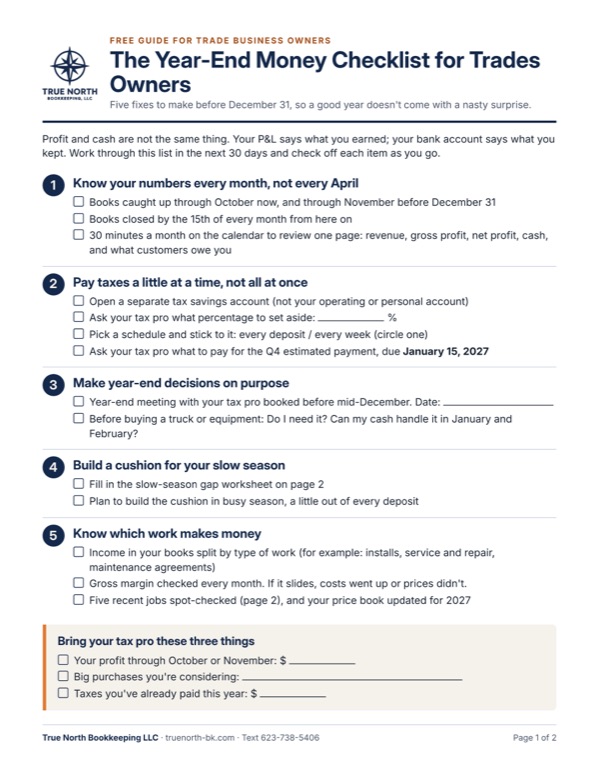
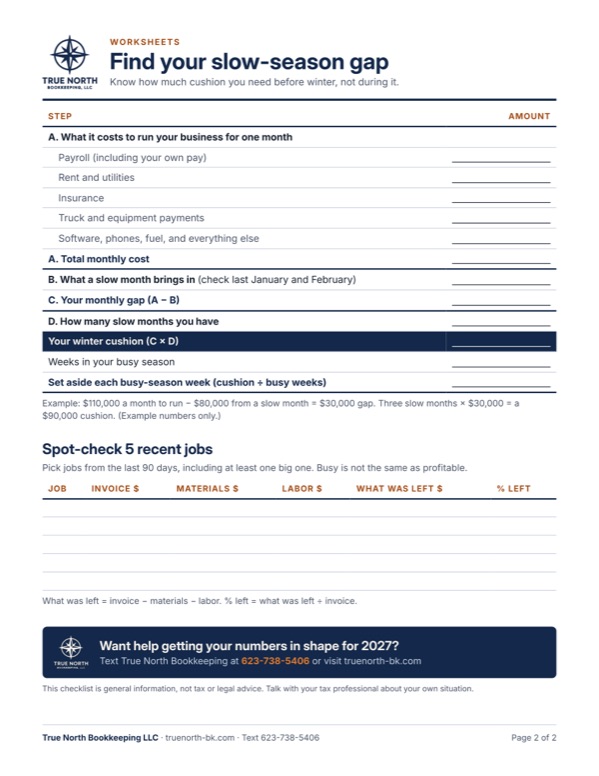
The free checklist puts all five on two printable pages, with a fill-in worksheet for your slow-season gap and a five-job spot-check table.
Your next 30 days.
Start with the first item: getting your books caught up. Everything else on the list depends on knowing your real profit.
Example from the checklist: a company that costs $110,000 a month to run and brings in $80,000 in a slow month has a $30,000 gap. With three slow months, that’s a $90,000 cushion to build before winter. (Example numbers only.)
- Get your books caught up through October now, and through November before December 31
- Open a separate tax savings account and ask your tax preparer what percentage to set aside
- Ask your tax preparer what to pay for the Q4 estimated payment, due January 15, 2027
- Book a year-end meeting with your tax preparer before mid-December
- Before you buy a truck or equipment, ask: do I need it, and can my cash handle it in January and February?
- Work out your slow-season gap and plan to build the cushion a little out of every busy-season deposit
- Split income by type of work, check gross margin monthly, and spot-check five recent jobs
- Update your price book for 2027
What’s in the checklist.
Two pages you can print and fill in by hand. It comes by email as a PDF.
- The five fixes as a checklist you can tick off in the next 30 days
- The three things to bring your tax preparer before mid-December
- A fill-in worksheet to find your slow-season gap and winter cushion
- A spot-check table to see what five recent jobs really left you
Questions about year-end money.
Why is there no money in the bank after a profitable year?
Because a lot of cash leaves your business without showing up as an expense. Owner draws, loan principal, equipment down payments, customers who owe you more and extra parts on the shelf all use cash but don’t lower profit. Taxes are figured on the profit, so plan for them before December 31.
How much should I set aside for taxes?
It depends on your business structure, your state and your income, so ask your tax preparer for a percentage. What you need first is an accurate profit number, which is why the checklist starts with getting your books caught up.
Should I buy a truck or equipment before December 31?
Only if you need it. A write-off lowers taxable profit, but you still spend the cash, and January and February are often tight. Bring your profit through October or November to your tax preparer and decide together.
My books are months behind. Is it too late for this year?
No. A few months of catch-up is very doable before year-end, and even books caught up through October give your tax preparer something real to plan with. If they’re further behind, a Compass Calibration ($250) shows what it will take.
Get the checklist
This checklist is general information, not tax or legal advice. Talk with your tax professional about your own situation.
Bookkeeping for your trade.
Each trade page covers the money problems that trade runs into, and how monthly books fix them. Monthly bookkeeping starts at $500 a month.
Questions about your numbers? Text me.
Most trades owners would rather text than call. Send a question from the truck and I’ll get back to you, or book a free 15-minute Numbers Check call if you’d rather talk it through.