

The Trades Money Dictionary, Part 1: Bookkeeping Basics
Quick answer
- Bookkeeping records every dollar in and out; accounting uses those records to plan, file taxes and make decisions.
- A chart of accounts is the list of categories your books sort money into.
- Cash-basis books count money when it moves; accrual-basis books count it when the work is done or the bill is owed.
- A bank reconciliation checks that your books match your bank statement, line by line.
The full answer
Welcome to the Trades Money Dictionary: 40 money terms every electrical, plumbing, HVAC and painting company owner should know, four at a time, explained with examples from the job site instead of the classroom. Part 1 covers the four basics everything else is built on.
1. Bookkeeping vs. accounting
What it is: Bookkeeping is the day-to-day record of your money: every sale, every supplier bill, every fuel purchase on the company card, sorted and checked. Accounting takes those records and uses them to look ahead: tax planning and filing, bigger financial decisions, and reports for lenders.
Think of it as a compass and a map. Your bookkeeping is the compass: it tells you exactly where you stand right now. Accounting is the map: it helps you plan where to go next. A map is only as good as the compass reading you start from.
On the job: you want to know whether the Martinez kitchen rewire got paid. That's a bookkeeping question. You want to know whether to buy a second van this year or wait. That's a question for your accountant, and they'll need clean books to answer it.
Why it matters: if the bookkeeping is a mess, your tax preparer spends billable hours untangling the past instead of planning your future, at their rate, not a bookkeeper's.
2. Chart of accounts
What it is: the list of categories your books use: income accounts (like Service Income and Install Income), expense accounts (like Materials, Subcontractors, Vehicle Fuel), plus accounts for what you own and owe.
On the job: a plumbing company that lumps everything into "Supplies" can't tell how much went to job materials versus shop supplies versus small tools. Splitting those accounts shows where the money actually goes.
Why it matters: your reports can only be as detailed as your chart of accounts. Set it up around how a trades company really spends: job materials, subs, labor, trucks and equipment, kept separate from office overhead. Too many accounts is as unhelpful as too few; aim for the categories you'd actually make decisions with.
3. Cash vs. accrual books
What it is: two ways of deciding when income and expenses count.
- Cash basis: income counts when the money arrives; expenses count when you pay them.
- Accrual basis: income counts when the work is done and invoiced; expenses count when you get the bill, even if you haven't paid it yet.
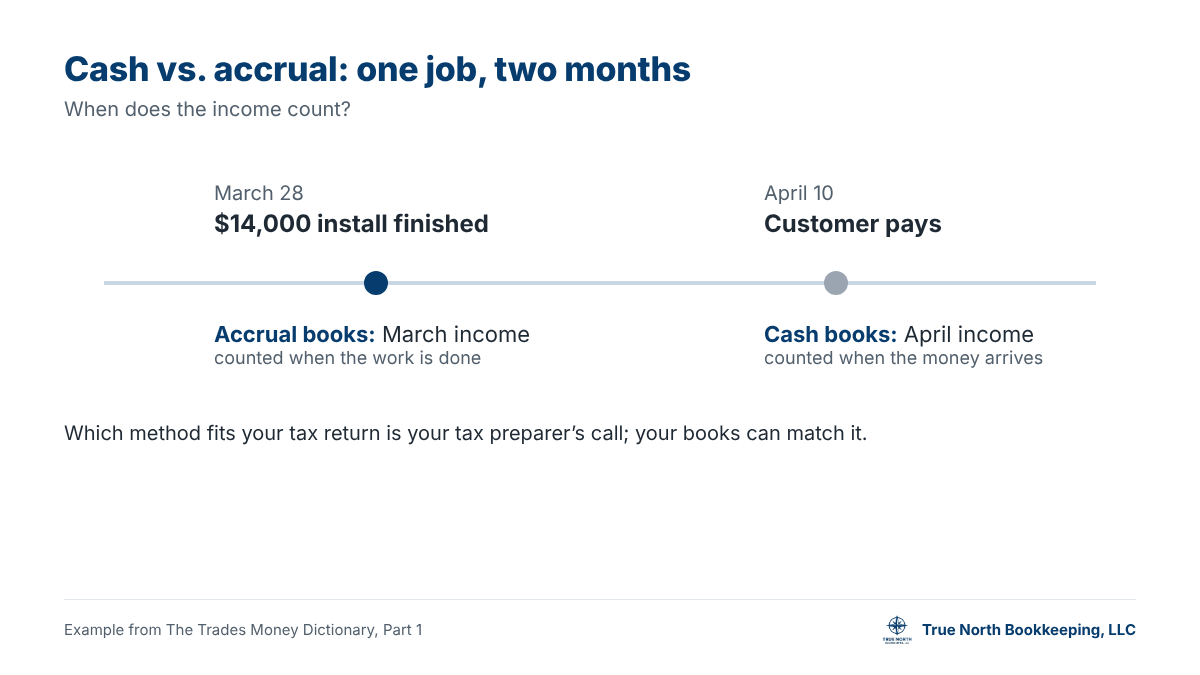
On the job: an HVAC company finishes a $14,000 install on March 28, and the customer pays on April 10. On cash-basis books, that's April income. On accrual-basis books, it's March income, because March is when the work was done.
Why it matters: accrual books match each job's income with its costs in the same month, which gives a truer picture of profit. Cash books are simpler and show what actually hit the bank. Many small companies keep cash-basis books; some need accrual. Which method you use for your tax return is a decision for your tax preparer, and your bookkeeper can keep the books to match.
4. Bank reconciliation
What it is: checking your books against your bank and credit card statements every month, line by line, until the balances agree. Anything that doesn't match gets found and fixed.
On the job: the statement shows a $1,240 supply-house charge your books don't have, because the receipt never made it out of the truck. Without a reconciliation, that cost is missing from your books, and every job and every report looks more profitable than it really is.
Why it matters: reconciliation is what makes the rest of your numbers trustworthy. Unreconciled books are a guess: they can miss expenses, count a deposit twice, or hide a duplicate charge. It's the first thing a lender or tax preparer will want to see done. It's also question 1 on the Financial Health Scorecard for that reason.
What to do this week
- Ask whether your books are on a cash or accrual basis, and why.
- Open your chart of accounts and look for catch-all categories like "Supplies" or "Miscellaneous" that hide too much.
- Check the date your bank account was last reconciled in your books.
How True North helps
True North Bookkeeping reconciles every account each month, sets up a chart of accounts built for trades companies, and keeps your books ready for your tax preparer. If you're not sure where your books stand, a Compass Calibration ($250) reviews your QuickBooks Online or Xero file and gives you a written roadmap.
Take the free Financial Health Scorecard to see how your books measure up in 3 minutes. Questions? Text Stephen at 623-738-5406.
Next in the series: Part 2, Your profit report: revenue, the profit and loss statement, gross profit and net profit.